

From AI-assisted surgical planning to teleoperated robotic systems, the global shift toward robotic and minimally invasive surgery is transforming modern medicine. Driven by the need for precision, safety, and faster recovery, this field has become one of the most exciting frontiers in healthcare technology.
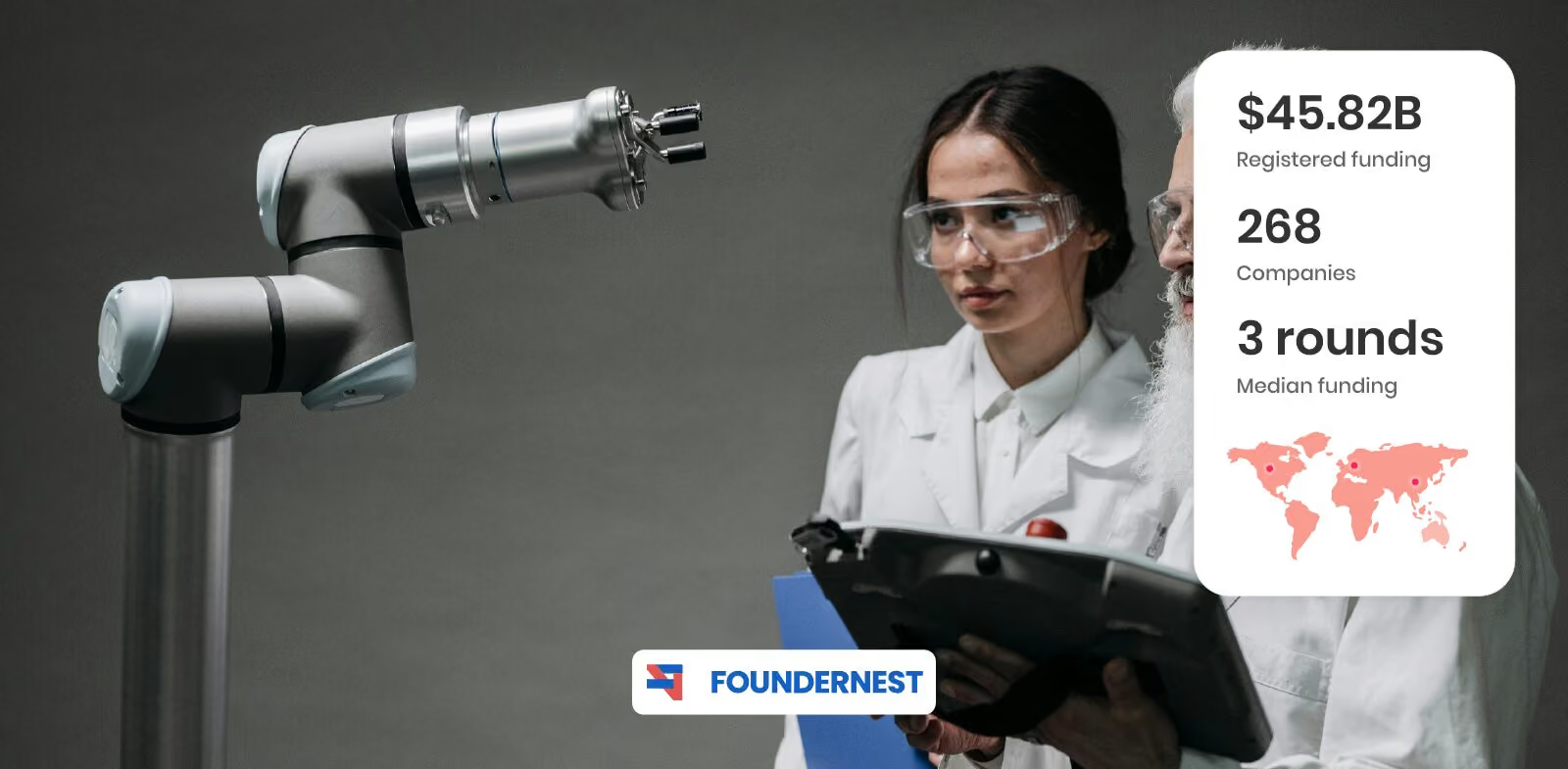
FounderNest identified 268 companies innovating across eight core subspaces, collectively raising over $45.82 billion in public funding rounds as of October 2025. The ecosystem includes surgical robotics pioneers, augmented reality innovators, and simulation platforms that are redefining surgical training and patient outcomes.
Key market trends
Robotic surgical systems
The most well-funded and technologically mature segment, with 56 companies raising $23.9B across 152 rounds. Industry leaders such as Medtronic and Intuitive Surgical are driving precision automation through advanced robotics and AI-guided instruments. These systems enable surgeons to perform complex operations with unprecedented dexterity and minimal invasiveness.
Surgical navigation systems
Comprising 47 companies that have collectively raised $26.37B, this subspace focuses on technologies that enhance intraoperative accuracy through real-time imaging and guidance. Solutions here integrate 3D mapping, augmented visualization, and AI-driven decision support to reduce surgical errors and improve outcomes.
Minimally invasive surgical techniques
With 60 companies and $21.71B raised, this segment emphasizes approaches that minimize trauma and speed recovery. Innovations range from laparoscopic instruments to single-port and micro-incision systems that lower infection risks and hospital stays.
Endoscopic surgery
A foundational subspace of 54 companies and $16.54B raised, endoscopic surgery leverages natural orifices or small incisions for access. Ongoing innovations include high-definition imaging, optical coherence tomography (OCT), and flexible endoscopes for delicate procedures.
Augmented reality in surgery
This emerging area, with 29 companies and $25.45B raised, integrates AR overlays to guide surgeons during procedures. These systems improve visualization of anatomical structures, enhance spatial awareness, and are becoming increasingly common in orthopedic, neurological, and cardiovascular interventions.
Instrumentation and tool development
A critical support segment of 53 companies raising $16.27B, focusing on specialized instruments and smart tools. Innovations include magnetic levitation instruments, haptic feedback systems, and miniaturized robotics designed for microsurgery.
Surgical simulation and training
With 29 companies and $12.61B raised, this subspace develops high-fidelity simulators and VR training platforms. They enable surgeons to practice procedures in realistic virtual environments, improving skill acquisition while reducing patient risk.
Teleoperated surgery
Perhaps the most futuristic segment, encompassing 21 companies that have raised $19.5B. Enabled by 5G connectivity, these systems allow expert surgeons to perform procedures remotely, breaking down geographic barriers and expanding access to quality care worldwide.
Space snapshot
- Total companies analyzed: 268
- Total funding raised: $45.82 Billion
- Median number of rounds raised per company: 3 rounds
- Median amount raised per company: $18 Million
- Median headcount: 31 employees
- Median age (maturity): 14 years
- CAGR in companies (last 5 years): 2.8%
- CAGR in funding (last 5 years): 41.2%
- Company locations: United States (55%), Europe and Asia
- Top funders: Medtronic ($10.87B), HistoSonics ($4.88B), Philips ($4.23B), Siemens Healthineers ($4.06B), Samsung Electronics ($4.75B)
The hottest technologies in robotic and minimally invasive surgery
- 5G-Enabled Teleoperated Surgery: Allowing real-time remote interventions.
- Smart Surgical Instruments: Embedding sensors and data analytics for enhanced control.
- Haptic Feedback Systems: Providing tactile feedback to improve surgeon precision.
- Single-Port Surgery Robots: Reducing invasiveness with single incision access.
- AR & VR Surgical Visualization: Enhancing accuracy through real-time augmented overlays.
- AI in Surgical Planning: Optimizing preoperative and intraoperative decision-making.
- Magnetic Levitation Instruments: Enabling smoother and vibration-free control.
- Optical Coherence Tomography (OCT): Offering high-resolution imaging for endoscopic precision.
Emerging innovators: 13 of the next generation of surgical technology
A new wave of early-stage startups is reshaping how surgeries are performed, trained, and managed. Since 2023, several seed-stage companies have emerged, combining AI, robotics, and advanced materials to build more accessible, intelligent surgical solutions.
From nanorobotics for microsurgery to AI-driven telehealth operating systems, these innovators are poised to define the next decade of medtech growth.
Companies that may catch your eye in this space that have received previous funding:
1. Virtuoso Surgical
Virtuoso Surgical specializes in developing endoscopic robotic systems designed to enhance surgeon dexterity and precision during minimally invasive procedures.
Headquarters: Nashville, United States
Founded: 2016 Headcount: 1–10 Funding: $1.98M, Grant, Nov 2023 Investors: National Institutes of Health, Launch Tennessee Website: https://virtuososurgical.net/ LinkedIn: Virtuoso Surgical, Inc.
2. Endorobotics
Manufacturer of robotic endoscopic medical equipment focused on improving precision and control during minimally invasive surgeries.
Headquarters: Seoul, South Korea Founded: 2019 Headcount: 11–50 Funding: $13.09M, Series B, Aug 2023 Investors: Donghoon Investment, L&S Venture Capital, Mirae Asset Capital, Partners Investment, Pathfinder H, Premier Partners, TIPS Program, K Ground Ventures, KNet Investment Partners, KOSME, Seoul Business Agency(SBA), Magna Investment, Korea University Holdings Website: https://endorobo.com/ LinkedIn: EndoRobotics Co., Ltd.
3. Zeta Surgical
Zeta Surgical is redefining the standard of care through advanced robotic navigation systems that integrate real-time imaging and AI for enhanced surgical precision.
Headquarters: Boston, United States Founded: 2018 Headcount: 11–50 Funding: $13.93M, Series A, Jan 2025 Investors: Innospark Ventures, Artesian VC, Emles Advisors, George Bickerstaff, Particle Accelerator Limited (ParticleX), Reinforced Ventures, TSVC, Trevor Fetter, Vishal Rao, Y Combinator, Brinc Website: https://www.zetasurgical.com/ LinkedIn: Zeta Surgical
4. Scopia Surgical
Scopia Surgical revolutionizes the operating room with real-time AI-powered surgical visualization and navigation tools to support precision interventions.
Headquarters: Montréal, Canada Founded: 2024 Headcount: 1–10 Funding: $0.35M, Pre-Seed, Jan 2025 Investors: Not disclosed Website: https://scopia.tech/ LinkedIn: Scopia Surgical
5. Virtual Incision
Virtual Incision develops a miniaturized robotic surgical platform enabling minimally invasive procedures inside the body cavity, designed for mobility and accessibility.
Headquarters: Lincoln, United States Founded: 2006 Headcount: 51–200 Funding: $153.95M, Debt Financing, May 2025 Investors: Arboretum Ventures, Baird Capital, Bluestem Capital, Endeavour Vision, InVivium Capital, Invictum Capital, PrairieGold Venture Partners, cultivate(MD), NASA, Genesis Innovation Group, Sinopharm Capital, US Army, University of Nebraska Medical Center, Nebraska Angel Network Website: https://virtualincision.com/ LinkedIn: Virtual Incision
6. Synaptive Medical
Advanced neurosurgical solutions combining precision imaging, robotic visualization, and integrated data platforms for minimally invasive procedures.
Headquarters: Toronto, Canada Founded: 2012 Headcount: 51–200 Funding: $53.88M, July 2025 Investors: Linamar, Sensegain Asset Management, Espresso Capital, Audible Capital, General Atlantic, Quadrille Capital, Northview LifeSciences Website: https://synaptivemedical.com/ LinkedIn: Synaptive Medical
7. Asensus Surgical
Digital laparoscopic robotic surgery systems with augmented intelligence capabilities that enhance surgeon control, precision, and decision-making during minimally invasive procedures.
Headquarters: Durham, United States Founded: 2006 Headcount: 51–200 Funding: $474.94M, Acquired, Jun 2024 Investors: Karl Storz, Hercules Capital, Armentum Partners, Sofar, Oxford Finance LLC, Silicon Valley Bank, Aisling Capital, Intersouth Partners, Parish Capital Advisors, Quaker BioVentures, SV Health Investors, Synergy Life Science Partner Website: https://www.asensus.com/ LinkedIn: Asensus Surgical
8. Globus Medical
Advanced musculoskeletal implants and robotic-assisted surgical technologies for spinal and orthopedic procedures.
Headquarters: Audubon, United States Founded: 2003 Headcount: 5,001–10,000 Funding: $99M, IPO, Aug 2012 Investors: Clarus Ventures, AIG Investments, Goldman Sachs, KM Medical Software Website: https://www.globusmedical.com/ LinkedIn: Globus Medical
9. Moon Surgical
Surgical robotics for minimally invasive procedures, focusing on adaptive, collaborative systems that enhance surgeon control and optimize operating room efficiency.
Headquarters: Paris, France Founded: 2019 Headcount: 11–50 Funding: $92.21M, Series B, May 2023 Investors: NVentures, Sofinnova Partners, Cathay Capital, Fred Moll, M.D, GT Healthcare Capital Partners, Johnson & Johnson Robotics and Digital Solutions, Josh Makower, MD Start, Richard Leparmentier, Sacha Loiseau, Siddarth Satish, Yann Fleureau, MedTech Innovator, Bpifrance, AGORANOV Website: https://moonsurgical.com/ LinkedIn: Moon Surgical
10. BrainLAB
Digital medical technology for surgical navigation, radiation therapy planning, and operating room integration to optimize clinical workflows and patient outcomes.
Headquarters: Munich, Germany Founded: 1989 Headcount: 1,001–5,000 Funding: $7.3M, Private Equity, Sep 2018 Investors: EMH Partners, Intel Capital Website: https://www.brainlab.com/ LinkedIn: Brainlab
11. Operative Experience
Operative Experience develops high-fidelity, modular medical simulators that deliver ultra-realistic surgical, trauma, and pre-hospital training. Their systems feature interchangeable wounds, lifelike physiology, and software-driven scenarios to enhance skills, lower costs, and improve outcomes for healthcare and military professionals.
Headquarters: North East, United States Founded: 2008 Headcount: 1–10 Funding: $1M, Venture, Jun 2016 Investors: Keiretsu Capital, Keiretsu Forum Northwest Website: https://operativeexperience.com/ LinkedIn: Operative Experience, Inc.
12. Mentice
Virtual reality and physical simulation solutions for image-guided interventional procedures, enabling healthcare professionals and medical device companies to acquire procedural skills, conduct device training, and perform patient-specific rehearsals across neurovascular, cardiovascular, and peripheral vascular interventions.
Headquarters: Gothenburg, Sweden Founded: 1998 Headcount: 51–200 Funding: IPO, Jun 2019 Investors: Vinnova, Priveq Investment Website: https://www.mentice.com/ LinkedIn: Mentice
13. Perceive3D
Video-based surgical navigation and visualization software using computer vision and augmented reality for minimally invasive orthopedic procedures.
Headquarters: Coimbra, Portugal Founded: 2013 Headcount: 1–10 Funding: $2.84M, Grant, Jun 2017 Investors: Portugal Ventures, EASME Website: https://perceive3d.com/en LinkedIn: Perceive3D
Conclusion
Robotic and minimally invasive surgery is entering its next phase, where automation, intelligence, and connectivity converge. As technology continues to evolve, the boundary between surgeon and machine blurs, ushering in an era of precision healthcare that is safer, faster, and more globally accessible.
Download the market report
With FounderNest, we give you the best company scouting tool and valuable market intelligence from our AI analyst.
Comprehensive market coverage: 50m+ companies, 10bn+ data points, 160m+ patents, 160m+ papers and articles, 500k+ clinical trials, 100m+ authors and key opinion leaders, 115k+ research entities, and 300m+ smart insights - all in one AI market intelligence platform.
Spaces: Create a detailed market space using our AI prompts so you cut out the noise and focus on the companies that matter.
Key Contacts: Identify key decision-makers and their contact details using AI so you only get in touch with the ones that you'll gain most engagement from.
Funding: Get a clear picture of the funding rounds and their investors for each company in seconds.
… and much much more!

Market Report