


The core elements of effective acquisition pipeline management
Whether you're leading corporate development for a global enterprise or building a more disciplined acquisition programme for a growth-stage company, these principles can help improve both deal quality and execution outcomes.
Why M&A pipeline quality matters more than pipeline size
One of the most common misconceptions in corporate development is that a larger pipeline automatically leads to better acquisition outcomes.
The logic seems reasonable. If a team reviews enough companies, then attractive opportunities should eventually emerge. In reality, larger pipelines often create more noise than value.
When acquisition teams spend time reviewing loosely qualified targets, resources are diverted away from the companies that actually fit strategic priorities. Investment committees are forced to evaluate a growing number of marginal opportunities, and reporting can create the impression of progress even when very little meaningful deal activity is taking place.
Research from McKinsey has consistently shown that organisations adopting a programmatic approach to M&A outperform companies that pursue acquisitions opportunistically. Programmatic acquirers treat M&A as an organisational capability rather than a series of individual transactions. As a result, they tend to identify opportunities earlier, evaluate them more consistently, and allocate capital more effectively.
Importantly, superior performance does not come from simply reviewing more targets. It comes from creating a repeatable process that improves decision-making throughout the acquisition lifecycle.
For organisations focused on building an M&A pipeline, the goal should be quality before quantity.
A strong pipeline is not simply a database of potential targets. It is an operating framework that connects strategy, market intelligence, deal sourcing, screening, relationship development, and governance all into a single process.
Start with an acquisition thesis, not a target list
Most acquisition pipelines begin to drift long before any deal reaches an investment committee.
The root cause is often down to the organisation never defining a clear acquisition thesis.
Without strategic direction, sourcing efforts become reactive. Teams evaluate opportunities because they are available rather than because they support a defined business objective. And as a result, pipeline reviews become increasingly subjective and internal stakeholders struggle to align around which opportunities deserve attention.
A well-defined acquisition thesis provides a clear answer to important questions like.
The more specific these answers are, the more effective every stage of acquisition pipeline management becomes.
It means that screening criteria become easier to apply, sourcing efforts become more focused, and internal decision-making becomes faster because strategic priorities have already been agreed upon.
Industries such as AI, cybersecurity, industrial automation, and life sciences evolve rapidly. Market dynamics, competitive pressures, and technology trends can change significantly within a year. For that reason, many leading corporate development teams review and refine their acquisition thesis quarterly.
Regular updates help ensure that pipeline activity remains aligned with broader business strategy.
Build a multi-channel M&A deal sourcing strategy
Once a strategic thesis is established, the next challenge is generating a consistent flow of relevant opportunities.
A successful M&A deal sourcing strategy rarely depends on a single channel. The strongest pipelines combine multiple sources of intelligence and origin to create a balanced flow of opportunities.
Banker-led deal flow
These opportunities typically arrive with structured information, active sellers, and established transaction processes. However, banker-led deals are often highly competitive. Multiple buyers are usually involved, valuation expectations are higher, and pricing discipline can become more difficult to maintain.
For this reason, intermediary-led opportunities should be viewed as one component of a broader sourcing strategy rather than the sole source of pipeline activity.
Proprietary deal origination
Many of the highest-quality acquisitions originate outside formal sale processes.
Proprietary deal sourcing involves identifying companies before they enter the market and developing direct relationships with founders, owners, and management teams. This often creates advantages in valuation, access, and deal certainty.
The challenge is that proprietary origination requires patience.
Corporate development teams may spend years building relationships before a transaction opportunity emerges. That investment, however, can create a significant competitive advantage when acquisition discussions eventually begin.
Internal deal sourcing channels
Many organisations overlook valuable acquisition intelligence already available within the business.
Product teams, innovation groups, partnership managers, technical scouts, and business unit leaders often maintain relationships with emerging companies long before corporate development becomes aware of them.
Creating structured processes for capturing these insights can significantly improve pipeline quality without increasing sourcing spend.
Ecosystem monitoring
Acquisition teams are increasingly supplementing traditional sourcing methods with continuous ecosystem monitoring. This includes tracking:
The objective is simple: identify attractive companies before they become obvious acquisition targets. In many sectors, the companies discovered earliest are often the companies acquired on the most favourable terms.
The most effective M&A deal sourcing strategy combines these channels into a single acquisition pipeline rather than relying heavily on any one source.
Define acquisition target screening criteria before a deal appears
One of the quickest ways for an acquisition pipeline to lose focus is for every opportunity to be evaluated differently.
When acquisition target screening relies primarily on individual judgement, teams often arrive at inconsistent conclusions. Two analysts may assess the same company and reach completely different recommendations. Over time, pipeline quality becomes dependent on who reviewed the opportunity rather than how well it aligns with the organisation's acquisition strategy.
This is why leading corporate development teams establish screening criteria before opportunities enter the pipeline.
Predefined screening frameworks create consistency across sourcing, evaluation, and decision-making. They also allow teams to filter opportunities more efficiently, reducing the time spent on targets that are unlikely to progress.
Start with clear exclusion criteria
The first stage of acquisition target screening should focus on eliminating opportunities that do not meet minimum requirements.
These criteria will vary by organisation, but common examples include:
Applying these filters early prevents teams from investing time in opportunities that are unlikely to advance beyond initial review.
More importantly, it creates alignment across the organisation. Everyone involved in acquisition pipeline management understands which opportunities warrant further analysis and which do not.
Create a strategic fit scoring framework
After initial qualification, opportunities should be evaluated against a consistent set of strategic criteria.
A scoring framework does not need to produce a perfect answer. Its primary purpose is to create a repeatable basis for comparison.
The objective is not to reduce acquisition decisions to a spreadsheet.
Rather, the framework provides a common language for discussing opportunities across corporate development, business units, finance, and executive leadership.
Use screening data to improve future decisions
One of the biggest advantages of structured acquisition target screening is that it creates a historical record of decision-making.
Without documentation, organisations often repeat the same evaluation process every time a new opportunity appears. Lessons learned from previous transactions remain trapped within individual team members rather than becoming part of the broader M&A process.
By tracking screening outcomes over time, corporate development teams can identify patterns that allow organisations to refine their acquisition pipeline management process and improve qualification accuracy over time.
Build consistency without creating bureaucracy
Effective screening frameworks should improve decision-making without slowing it down.
A common mistake is creating highly detailed scoring systems that require extensive analysis before meaningful conversations can begin. In practice, early-stage screening should remain relatively lightweight.
The goal is not to conduct due diligence before engaging a target.
The goal is to identify which opportunities deserve deeper investigation and which can be deprioritised quickly.
When implemented correctly, acquisition target screening becomes a force multiplier for the entire M&A deal sourcing strategy. Teams spend less time evaluating poor-fit opportunities and more time developing relationships with companies that genuinely align with long-term strategic objectives.
Prioritise Targets Within Your Acquisition Pipeline
Not every company that passes an initial screen deserves the same level of attention.
One of the biggest challenges in acquisition pipeline management is deciding where to focus limited time and resources. Even well-defined acquisition criteria can produce dozens of viable targets. Without a clear prioritisation process, teams risk spreading their efforts too thinly across opportunities that vary significantly in strategic value and likelihood of execution.
Effective prioritisation balances two factors: strategic attractiveness and deal feasibility.
Strategic attractiveness measures how closely a target aligns with the acquisition thesis. Factors might include capability fit, market access, technology differentiation, customer relationships, or geographic expansion opportunities.
Deal feasibility considers whether a transaction is realistically achievable. Ownership structure, founder interest, financial performance, shareholder dynamics, valuation expectations, and integration complexity all influence feasibility.
Viewed together, these dimensions create a practical framework for ranking opportunities.
Prioritisation should never be treated as a one-time exercise. Companies evolve, leadership teams change, funding events occur, and market conditions shift. A target that sits on a watchlist today may become a high-priority opportunity six months later.
For this reason, leading corporate development teams review target rankings regularly and adjust priorities as new information becomes available.
Treat relationship development as a long-term investment
Many acquisition opportunities are won or lost long before a transaction process begins.
By the time a company formally enters a sale process, most buyers are working with the same information and competing under similar conditions. Relationships established years earlier often become the deciding factor in who gains access, who receives management attention, and who is viewed as the preferred acquirer.
This is particularly true in founder-led businesses.
Founders rarely wake up one morning and decide to sell because of a single outreach email. More often, acquisition discussions emerge gradually through conversations, partnerships, industry interactions, and trust built over time.
That is why relationship development should be treated as a core component of any M&A deal sourcing strategy rather than a secondary activity reserved for active opportunities.
Build institutional relationship capital
Relationship development should not depend on individual team members maintaining personal contact lists.
As acquisition programmes mature, organisations benefit from maintaining structured records of:
This information allows knowledge to persist even as teams evolve.
You already use CRM systems for sales and partnerships. Applying the same discipline to your acquisition pipeline management can significantly improve continuity and long-term sourcing effectiveness.
Use market intelligence to stay ahead of the market
Historically, many acquisition programmes relied heavily on banker introductions, conference networking, and periodic market reviews.
While those channels remain valuable, they are no longer sufficient on their own.
Today's most effective corporate development teams operate with continuous visibility into the sectors, technologies, and companies that matter most to their acquisition strategy.
Rather than asking which companies are currently available, they focus on identifying which companies are becoming strategically important.
This shift fundamentally changes how acquisition opportunities are sourced.
Monitor signals, not just companies
Companies rarely become attractive acquisition targets overnight.
Most exhibit signals long before they attract widespread attention.
Examples include:
When tracked consistently, these signals provide early indicators of growth, strategic momentum, and potential acquisition readiness.
Monitoring signals rather than simply maintaining lists of companies allows teams to identify opportunities earlier and engage from a position of greater insight.
How AI is changing acquisition pipeline management
Artificial intelligence is increasingly being used to support market mapping, target identification, and acquisition screening.
Rather than manually reviewing thousands of companies, corporate development teams can now analyse large company universes using custom strategic criteria in Claude or Perplexity.
They can help identify:
AI can surface opportunities and identify patterns, but strategic fit, relationship quality, and transaction viability still require experienced assessment.
In fact, AI tools and LLMs like Claude or ChatGPT may be able to surface high volume but the quality of the output leaves a lot to be desired which can often waste time instead of saving it.
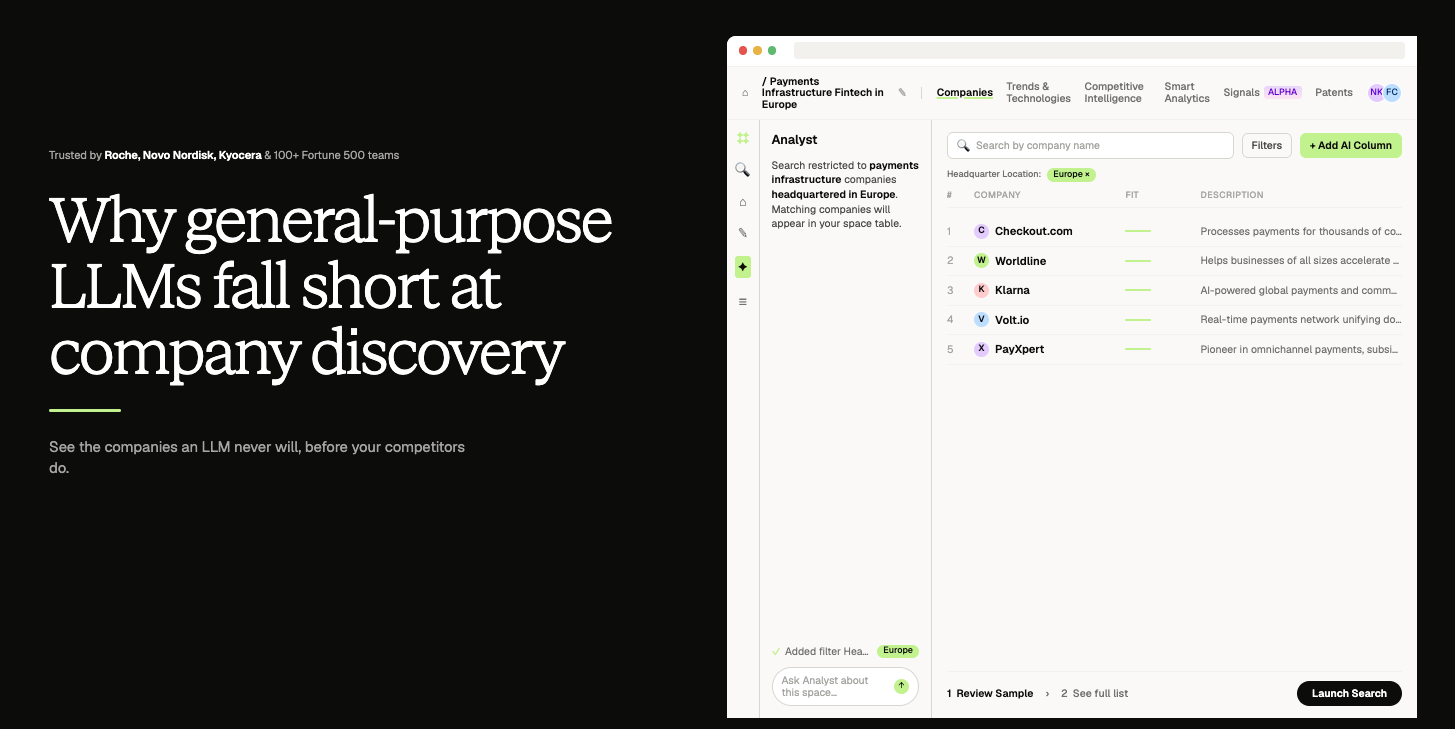
The best approach here is to use a market intelligence platform specifically crafted for company discovery and outreach that utilises AI over universal LLMs not built with that specific purpose in mind.
Organisations that combine this technology with disciplined sourcing processes are often able to identify opportunities earlier and build stronger proprietary deal flow.
Build governance processes that maintain pipeline momentum
Even a well-constructed acquisition pipeline can stall without effective governance.
Many organisations invest heavily in sourcing and screening but lack the internal processes needed to maintain momentum. As a result, promising opportunities lose visibility, relationships weaken, and pipeline priorities become disconnected from broader business objectives.
Governance should create structure without creating bureaucracy.
The objective is not to add approval layers. It is to ensure that opportunities receive appropriate attention and resources throughout the acquisition lifecycle.
Establish a regular pipeline review cadence
Pipeline reviews should occur regardless of whether active transactions are underway.
A consistent review cycle helps maintain organisational focus and creates accountability around sourcing activity.
A typical governance structure should include:
Weekly review
- New opportunities
- Pipeline additions
- Initial screening outcomes
- Market developments
Monthly reviews
- Relationship status updates
- Priority target discussions
- Strategic alignment reviews
- Resource allocation decision
Quarterly reviews
- Acquisition thesis updates
- Portfolio-level pipeline analysis
- Capital allocation discussions
- Market opportunity assessments
This approach helps organisations maintain continuity while adapting to changing market conditions.
Measure pipeline quality, not activity
Many corporate development teams track pipeline activity: companies reviewed, meetings held, or NDAs signed.
These metrics can be useful, but they do not necessarily indicate pipeline quality.
More valuable measures include:
Tracking these metrics helps teams identify which sourcing activities generate the strongest outcomes and where pipeline quality may be deteriorating.
The infrastructure behind a high-performing M&A pipeline
Building an M&A pipeline requires more than a target list.
Most successful acquisition programmes combine:
The specific tools and processes will vary by organisation, but the underlying objective remains the same: create a repeatable system that consistently identifies and develops high-quality acquisition opportunities.
Organisations that treat M&A as an ongoing capability rather than a series of isolated transactions tend to build stronger pipelines and achieve more consistent outcomes over time.
Key takeaways: Building an M&A pipeline
Building an M&A pipeline is not about reviewing more companies. It is about improving how opportunities are sourced, evaluated, prioritised, and developed.
The most effective acquisition programmes typically:
When these elements work together, acquisition pipeline management becomes a strategic capability rather than an administrative process.
Frequently asked questions about building an M&A pipeline
What is the difference between an M&A pipeline and deal flow?
Deal flow is the broader concept that refers to the total volume of opportunities that reach a team through any channel. An M&A pipeline is the structured system through which those opportunities are evaluated, progressed, and converted. A strong pipeline manages deal flow in a disciplined way; it is not simply a record of what has come through the door.
How many targets should be in a healthy M&A pipeline at any one time?
There is no universal answer, but quality matters far more than volume. A pipeline of 20 well-qualified targets that align clearly with the acquisition thesis will almost always outperform one of 200 loosely screened names. The right size depends on the organisation's deal pace, team capacity, and the depth of diligence applied at each stage.
How do you prioritise acquisition targets within a pipeline?
Prioritisation should be driven by a combination of strategic fit score, deal feasibility and urgency signals such as funding milestones, competitive dynamics, or leadership transitions. Prioritisation criteria should be revisited regularly, as what is high priority today may not be in six months.
What is proprietary deal flow and why does it matter for M&A?
Proprietary deal flow refers to opportunities developed through the acquirer's own outreach and relationships, outside of formal banker-run processes. It matters because proprietary deals typically involve less competitive pressure, better pricing dynamics, and a more collaborative relationship with the target from the outset. Building proprietary flow requires sustained relationship investment, but the return on that investment is typically significant.
How is AI changing M&A pipeline management in 2026?
AI is having its most significant impact at the top of the acquisition funnel in target identification, market mapping, and early-stage screening. Machine learning models can surface candidates from large company universes based on custom criteria and identify sell-side readiness signals before formal processes begin. According to Deloitte's GenAI in M&A Survey, 86% of organisations have now integrated generative AI into their M&A workflows. The teams getting the most value are those using it to expand the intelligence layer of their pipeline, not just automate screening tasks.
How often should the acquisition thesis be reviewed?
In fast-moving sectors, quarterly is advisable. At minimum, the thesis should be reviewed biannually and whenever a significant market event materially changes the landscape in a priority area.
What is the most common reason M&A pipelines underperform?
The most common root cause is misalignment between the pipeline and a clearly defined strategic thesis. When deal sourcing is not anchored to specific capability goals or market priorities, teams waste time on targets that will never survive internal review and the pipeline becomes a record of activity rather than a driver of strategic progress.
Research sources
McKinsey & Company: The Seven Habits of Programmatic Acquirers, What Programmatic Acquirers Do Differently
Bain & Company: M&A Capability for a New Era (2026), Looking Back at M&A in 2025, Global M&A Report 2026
Deloitte: 2025 GenAI in M&A Survey, 2026 M&A Trends Survey

Market Report