

From protection to performance: How innovation leaders are redefining what and how they measure
Innovation isn’t just about bold ideas anymore, it’s about bold measurement. As organizations shift from invention to impact, the way they track innovation is undergoing a quiet revolution. In 2025, we’re seeing a transformation in how companies define success, allocate budgets, and hold themselves accountable.
In fact, the very KPIs that once guarded intellectual property are now being replaced by forward-facing, tech-enabled metrics that focus on speed, outcomes, and adaptability.Let’s take a closer look at the changing innovation measurement landscape.
1. KPI evolution: From protection to performance
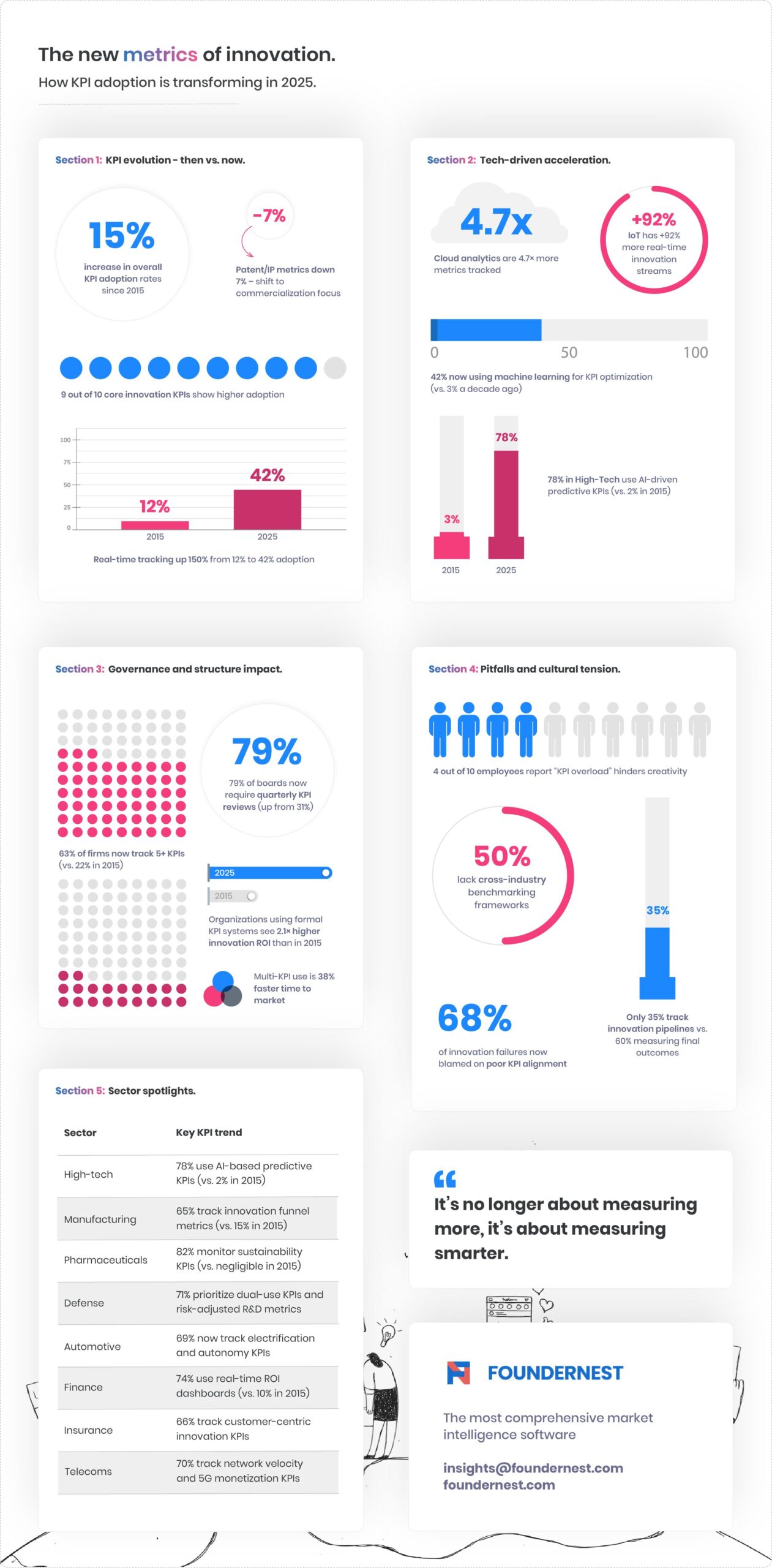
Innovation KPIs are no longer static, retrospective indicators, they’ve become dynamic performance drivers. Since 2015, overall KPI adoption has risen by 15 percentage points, with 9 out of 10 core innovation metrics seeing higher usage.
📉 Notably, patent/IP metrics have declined by 7%, as companies move away from defensive innovation toward commercialization and time-to-market priorities.
📈 Meanwhile, real-time tracking has skyrocketed, with adoption jumping from 12% to 42% - a 150% increase, fueled by data infrastructure advances.
Visual shift: Organizations are migrating from measuring what was invented to tracking how fast those inventions create value.
2. Tech-driven acceleration
Behind this KPI renaissance? Technology.
Cloud-based analytics platforms now enable firms to track 4.7× more innovation metrics than manual or spreadsheet-based systems.
IoT infrastructure is supercharging real-time measurement, delivering 92% more live innovation data streams than a decade ago.
AI and ML are also stepping into the spotlight:
- 42% of innovation teams now use machine learning to optimize KPIs (up from 3% ten years ago).
- In the high-tech sector alone, 78% now rely on AI-driven predictive KPIs, a seismic shift from just 2% in 2015.
3. Governance and structure: From quarterly reporting to ROI multipliers
Innovation measurement isn’t just operational—it’s becoming a board-level priority.
- 79% of boards now require quarterly KPI reviews (vs. just 31% in 2015).
- Companies using formal KPI systems achieve 2.1× higher innovation ROI than those without.
- Firms tracking five or more KPIs have surged from 22% in 2015 to 63% today.
- And those using multi-dimensional KPIs see 38% faster time-to-market.
Translation: When structure supports innovation measurement, performance accelerates.
4. Cultural tension: When KPIs help, and hurt
For all their upside, KPIs are not without risk. Over-measurement and misalignment can quietly sabotage innovation from the inside.
- 68% of innovation failures are now blamed on poor KPI alignment, up sharply from a decade ago.
- 41% of employees report suffering from “KPI overload,” citing it as a barrier to creativity and experimentation.
- Only 35% of organizations track early-stage pipeline metrics, while 60% focus on final outcomes - potentially missing key drop-off points.
- 57% lack cross-industry benchmarking, making it difficult to contextualize success.
The challenge now is balance: ensuring measurement drives clarity, not compliance.
5. Sector spotlights: How KPI adoption looks across industries
Innovation doesn’t wear the same uniform in every industry. Here’s how leading sectors are evolving their KPI playbooks:
High-Tech: 78% use AI-based predictive KPIs (vs. 2% in 2015)
Manufacturing: 65% track innovation funnel metrics (vs. 15%)
Pharma: 82% monitor sustainability KPIs (vs. negligible in 2015)
Defense: 71% prioritize dual-use and risk-adjusted R&D KPIs
Automotive: 69% track electrification and autonomy innovation KPIs (vs. 12%)
Finance: 74% use real-time ROI dashboards (vs. 10%)
Insurance: 66% track customer-centric innovation KPIs (e.g., claims AI, personalization)
Telecom: 70% track network velocity and 5G monetization KPIs (vs. 18% in 2015)
A final thought: Measurement with intent
KPI systems are no longer just back-office frameworks, they’re front-line tools shaping innovation outcomes. But as the data gets richer and the tools more advanced, one truth becomes clear:
🗣️ “It’s no longer about measuring more, it’s about measuring smarter.”
Leaders who can harness this measurement evolution, not just to report, but to steer innovation will be the ones best positioned to turn ideas into impact in 2025 and beyond.

Market Report