


Innovation teams today are caught in one of the strangest contradictions in business. Senior executives declare a bold ambition: “We want to disrupt our industry, transform our business model, and leapfrog competitors.” Yet the same executives often measure progress through quarterly dashboards designed for efficiency and incremental improvements.
This misalignment is more than just a frustration for innovation teams. It creates what we call the Mixed Mandate Matrix - an environment where teams are asked to deliver both quick wins and long-term transformation simultaneously. The predictable outcome? Innovation theater, endless rebrands, and demoralized teams wondering if their work really matters.
If you’ve ever been asked to “create something disruptive” in one meeting and then told to “just get me a pilot by next quarter” in the next, you already know about this dilemma. The challenge is not simply tactical - it is cultural, structural, and strategic.
The fundamental tension: Quick wins vs. business transformation
Business transformation, by definition, requires time. It involves building new capabilities, shifting structures, rethinking business models, and rewiring incentives. These are multi-year efforts. Yet in many organizations, innovation teams are evaluated with borrowed metrics: quarterly ROI, immediate cost savings, and utilization rates.
This tension manifests in several ways:
- Quarterly review cycles punish investments with long gestation periods.
- Operational metrics are applied to innovation groups, even though they weren’t designed for high-uncertainty, long-horizon work.
- Stakeholder impatience drives teams to optimize for visibility rather than progress.
The result is often innovation signaling: hackathons, flashy demos, and pilot programs that generate press releases but little structural impact. Teams burn cycles proving they are innovative rather than actually innovating.
Mapping the Mixed Mandate Matrix
The Mixed Mandate Matrix is a simple framework for understanding these conflicting pulls. It maps innovation activity along two axes:
- Time horizon (short-term → long-term)
- Impact area (brand signaling → structural change)
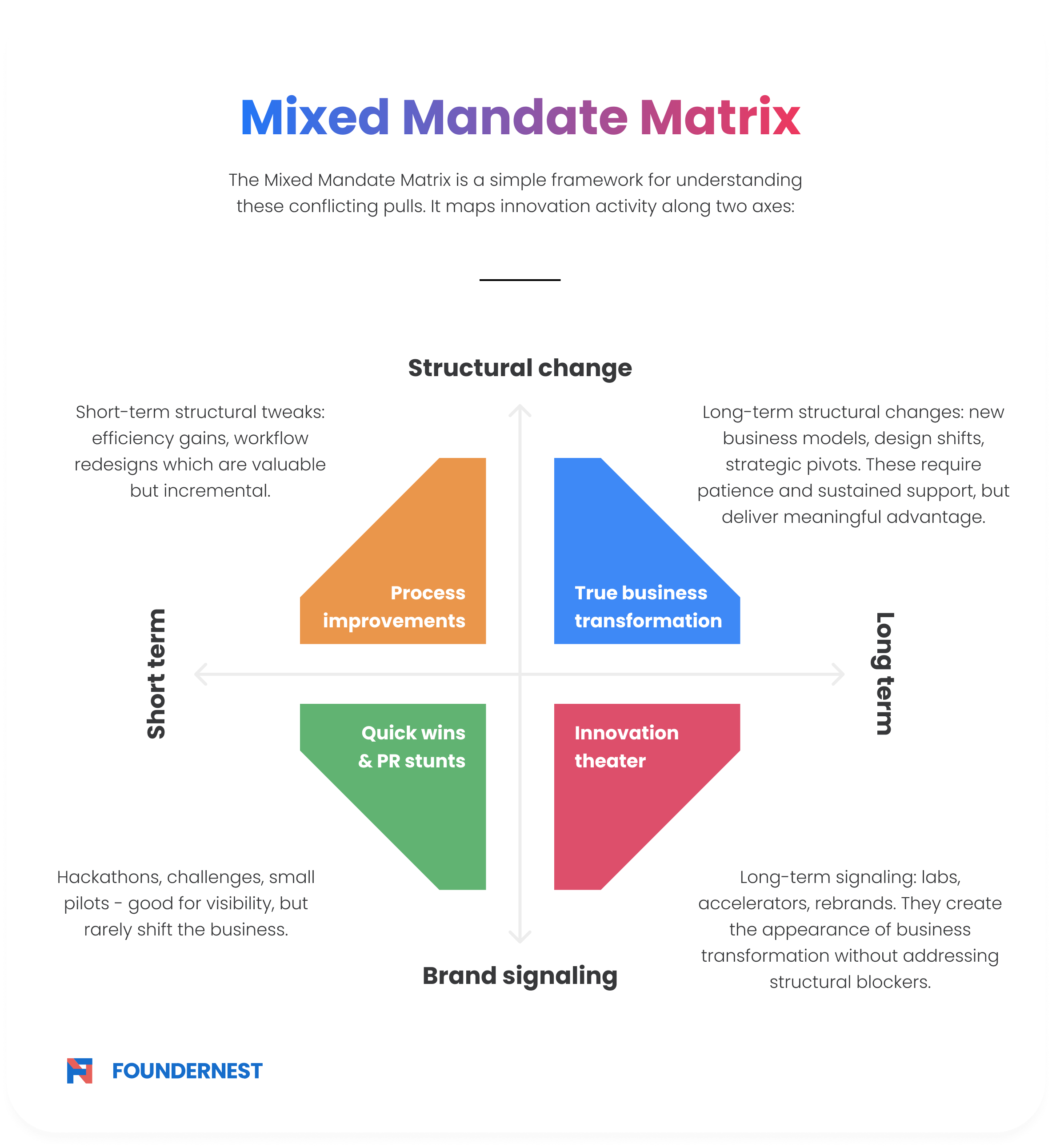 This creates four quadrants:
- Quick wins & PR stunts
- Hackathons, challenges, small pilots - good for visibility, but rarely shift the business.
- Innovation theater
- Long-term signaling: labs, accelerators, rebrands. They create the appearance of business transformation without addressing structural blockers.
- Process improvements
- Short-term structural tweaks: efficiency gains, workflow redesigns which are valuable but incremental.
- True business transformation
- Long-term structural changes: new business models, organizational design shifts, strategic pivots. These require patience and sustained support, but deliver meaningful advantage.
Most corporate portfolios are overweight in Quadrants 1 and 2 because they are visible, safe, and politically convenient. Unfortunately, only Quadrant 4 produces real competitive differentiation.
Why mixed signals hurt innovation
Mixed mandates don’t just waste time. They actively weaken a company’s ability to innovate. By focusing on immediate wins, teams under-invest in building transformational muscles like ecosystem partnerships, business model experimentation, and long-cycle R&D.
Employees quickly learn that “innovation” means branding exercises, not meaningful change, and each rebrand further erodes trust. Meanwhile, resources become scattered across too many small projects, making no meaningful progress toward strategic ambitions.
Over time, the organization not only fails to deliver breakthrough innovation, it damages its credibility and its internal capacity to even attempt it.

Case study: Amazon’s patient approach to business transformation
Amazon is a rare example of a company that has consistently resisted the quick-win trap. When it launched AWS in 2006, the service generated little revenue and was outside Amazon’s core retail business. Many investors were skeptical.
But Amazon measured AWS not by quarterly ROI but by customer adoption and developer engagement. Leadership communicated clearly that this was a long-term bet on infrastructure as a service. Today, AWS is Amazon’s most profitable business, responsible for billions in operating income.
By setting innovation-specific metrics (developer uptake, ecosystem growth) instead of forcing AWS into retail’s quarterly ROI lens, Amazon gave the project space to become transformational.
The prioritization dilemma: Too many asks, too little focus
If you talk to innovation leaders across industries, you’ll hear the same story: “We have too many priorities, too many projects, and not enough clarity.” This isn’t surprising. Leaders often fear missing out, so they say yes to everything. The irony is that this “do it all” approach actually achieves the opposite: nothing gets done well.
The way forward is disciplined portfolio management which includes:
- Define Ambitions
- Set no more than three tangible, specific ambitions. For example: “Grow revenue from non-core businesses by 20% in 5 years,” or “Launch two new business models by 2028.”
- Identify Challenges
- What is blocking progress? Talent gaps? Regulatory hurdles? Customer adoption issues? Naming the challenges creates clarity.
- Review and Prune
- Ruthlessly cut initiatives that don’t align to ambitions or overcome identified challenges.
This approach feels tough, but clarity creates momentum. If a project doesn’t directly move your ambition forward, it doesn’t belong in the portfolio.

Case study: Google X and the power of pruning
Google X (now simply X, the Moonshot Factory) provides an instructive model. Projects like Google Glass and Project Loon were highly publicized but ultimately shut down. From the outside, this looks like failure but from the inside, it was portfolio discipline at work.
X follows a “kill fast” philosophy: if a project cannot prove it has both technical feasibility and scalable business potential, it’s cut (even if it generates excitement). Resources are then redirected toward projects with stronger transformational potential (e.g., Waymo, drone delivery).
This shows that innovation teams must be willing to prune aggressively, even at the cost of visibility, to preserve capacity for long-term plays.
Defining your own innovation metrics
Another way to escape the quick-win trap is to stop relying on borrowed metrics and instead design a measurement system purpose-built for innovation.
Effective frameworks balance across four categories:
- Input Metrics: Resources and energy devoted (budget allocation, pipeline of ideas, partnerships scouted).
- Process Metrics: How effectively the team moves ideas forward (conversion rates, cycle times, learning milestones).
- Output Metrics: Tangible deliverables (prototypes, launches, patents).
- Outcome Metrics: Business impact (revenue from new products, market share, customer engagement).
The right portfolio is usually just 5–8 metrics total, with at least one from each category. Too many metrics create noise and confusion and with too few, the team looks disconnected from outcomes.
Critically, leaders must resist the temptation to apply short-term incentives to long-term bets. If rewards are tied only to immediate product launches, teams will optimize for that. If the goal is true business transformation, then metrics, staffing, and incentives must be aligned accordingly.

Case study: GE and the pitfalls of misaligned metrics
General Electric’s much-publicized “GE Digital” initiative in the mid-2010s illustrates the dangers of misalignment. GE invested heavily in the Predix platform, aiming to transform itself into a “digital industrial company.”
The rhetoric was transformational, but the measurement remained operational. Business units demanded short-term revenue from Predix, even as the platform required years of ecosystem development. As a result, GE prioritized quick revenue deals over platform scalability.
The initiative stumbled, contributing to broader organizational challenges. This goes to show that even with massive investment and executive support, innovation collapses when metrics demand quick wins that undermine long-term goals.
Pushing back gracefully: The art of strategic resistance
Innovation professionals often find themselves in uncomfortable situations: being asked to “make this project more innovative” after all decisions are made, or being told to prioritize “just one quick win” when their mandate is transformation.
Saying no outright can alienate stakeholders. Saying yes undermines your team’s mission. The skill to develop is strategic resistance - pushing back in ways that build trust and clarity.
Practical strategies include:
- Acknowledge and validate: “I understand why quick results feel urgent.”
- Reframe the ask: “Here’s how we can provide early visibility without sacrificing long-term impact.”
- Use data strategically: Show how initiatives balance across horizons.
- Set boundaries: “To stay on budget, we need to prioritize these features now and save others for phase two.”
Handled well, resistance becomes education. Over time, stakeholders can begin to understand the difference between innovation theater and true business transformation.
Communicating innovation’s value
A persistent challenge for innovation teams is the dreaded question: “What do you guys even do?” The reality is that innovation outputs are often intangible, long-cycle, and cross-functional. That makes attribution difficult. But it also makes communication more important.
Best practices in innovation communication require tailoring messages to the audience. Finance cares about risk-adjusted growth, operations focuses on efficiency, and customer-facing teams prioritize differentiation.
Abstract numbers should give way to stories: “This pilot revealed a billion-dollar whitespace,” or “This prototype helped us close a strategic deal.” Credibility also comes from transparency, so it’s important to acknowledge risks openly rather than glossing over them.
In the end, storytelling, not spreadsheets, is what convinces stakeholders that innovation truly matters.
Strategic recommendations: Escaping the mixed mandate trap
To move beyond the paradox of business transformation vs. quick wins, organizations must:
- Acknowledge the contradiction: stop pretending quick wins and transformation are the same.
- Establish governance: create explicit innovation mandates with delegated authority.
- Balance the portfolio: across horizons, with metrics tailored to each.
- Invest in capability: not just projects, but processes, skills, and culture.
- Embed education: so every function sees how innovation advances its goals.
The Three Horizons framework offers a practical model: ~70% of resources in Horizon 1 (core), 20% in Horizon 2 (adjacent), and 10% in Horizon 3 (transformational bets). The key is recognizing that Horizon 3 cannot be judged with Horizon 1 metrics.
Conclusion
The paradox of “transformation measured by quick wins” is one of the deepest challenges innovation teams face today. Left unaddressed, it leads to signaling over substance, cynicism over progress, and wasted potential.
However, organisations that confront the contradiction by designing their own metrics, pruning their portfolios, and communicating strategically can develop genuine innovation capabilities. The ones that succeed will not only adapt to change; they will shape it.
That’s because business transformation is never a quick win. It’s the cumulative outcome of patience, clarity, and structural commitment. The companies that master this balance will thrive in disruption and the ones that don’t risk repeating GE’s missteps.
In the end, the choice is simple: do you want innovation theater and a rebrand, or do you want real business transformation? Your measurement system will decide.

Market Report